

Description
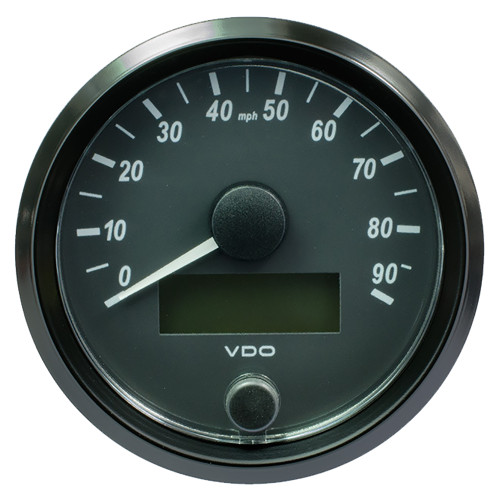
VDO SingleViu Speedometer 160 MPH | Boat Supply Store
For performance-oriented vessels and complex marine electronics installations, this VDO SingleViu speedometer provides precise velocity tracking up to 160 MPH. Its integrated onboard microprocessor and dual-input capability ensure seamless communication with both traditional 0-400kHz analog senders and modern J1939 CAN networks. The robust, waterproof 80mm housing features customizable RGB illumination and a diagnostic fault code display, making it an indispensable instrument for offshore fishing boats or high-speed center consoles operating on the Gulf Intracoastal Waterway.
Key Features
- Dual-input capability for analog or J1939 CAN signals.
- Onboard microprocessor for independent, reliable operation.
- J1939 fault code display for enhanced system diagnostics.
- Waterproof and fog-proof construction for marine environments.
- Customizable RGB LED illumination to match helm aesthetics.
- Advanced stepper motors for exceptionally accurate readings.
- Spin-Lok™ mounting for secure and simple installation.
- Includes comprehensive wire harness with high-quality connectors.
Specifications
| Product Specifications | |
|---|---|
| Diameter | 80mm (3-1/8") |
| Max Speed | 160 MPH |
| Input Type | Analog (0-400kHz default) & J1939 CAN |
| Voltage | 12-24V |
| Construction | Waterproof/Fog-proof |
| Illumination | RGB LED |
| Mounting | Spin-Lok™ |
| Connector | Molex MX 150 (8 & 12 Pin) |
| Microprocessor | Onboard |
| Fault Code Display | J1939 |
Who This Is For
Marine enthusiasts and professional installers requiring advanced instrumentation that bridges analog and digital marine networks. This gauge is designed for those who demand precision, durability, and customizable aesthetics for their vessel's helm.
How It Compares
| Feature | VDO SingleViu Speedometer 160 MPH | Competitor |
|---|---|---|
| Max Speed | 160 MPH | Displays speed data from connected sensors (variable max), 70 MPH |
| Input Type | Analog (0-400kHz default) & J1939 CAN | NMEA 2000, Analog |
| Illumination | RGB LED | Backlit LCD, Incandescent |
| Waterproof Rating | Water Resistant Front & Rear | IPX7, Not specified |
| Voltage | 12-24V | 12V DC, 12V |
| Gauge Diameter | 80mm (3-1/8") | 4 inch display (requires larger cutout), 3-3/8 inches |
Common Concerns Answered
Is the configuration software for the J1939 CAN bus integration user-friendly?
While the J1939 CAN bus integration offers advanced capabilities, some users find the configuration software has a learning curve. For straightforward analog setups, configuration is minimal, focusing on calibration rather than complex network settings.
Why is this VDO speedometer priced higher than basic analog models?
The higher price reflects the advanced dual-input technology (analog and J1939 CAN), onboard microprocessor for independent operation, diagnostic fault code display, and customizable RGB illumination, features not found on basic analog speedometers.
Is the display size adequate for quick readability at speed?
The 80mm (3-1/8") diameter is a standard gauge size for flush mounting. While it provides excellent detail, users prioritizing larger displays for at-a-glance readability might consider integrated multi-function displays if space allows.
Frequently Asked Questions
Can the VDO SingleViu Speedometer be used with both analog and digital (J1939 CAN) senders?
Yes, the VDO SingleViu Speedometer features dual-input capability, allowing seamless integration with both analog senders (0-400kHz default) and J1939 CAN networks.
What is the maximum speed this speedometer can display?
This speedometer is engineered to display speeds up to a maximum of 160 MPH.
Is the VDO SingleViu Speedometer waterproof?
Yes, the VDO SingleViu Speedometer is constructed to be waterproof and fog-proof, ensuring reliable performance in harsh marine environments.
What is the voltage range for this speedometer?
The VDO SingleViu Speedometer is compatible with a standard marine voltage range of 12-24V.
Can this speedometer display J1939 system fault codes?
Absolutely, a key feature of this speedometer is its ability to display J1939 system fault codes directly on the gauge, aiding in diagnostics.