
Description
Digital Yacht PilotLINK2 WiFi AIS Interface | Boat Supply Store
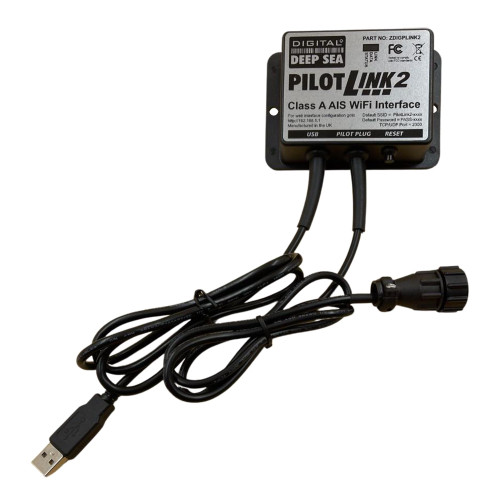
For vessels equipped with older Class A AIS transponders featuring a standard 'Pilot Plug' interface, the PilotLINK2 provides a direct wireless data bridge to modern navigation platforms. This compact, USB-powered unit creates a secure Wi-Fi network, enabling Class A static, dynamic, and voyage data transmission to mobile devices and computers without requiring a new transponder installation. It supports TCP/IP and UDP protocols, offering broad compatibility with hundreds of navigation applications and including a raw data logging function for post-voyage analysis, ideal for commercial fishing vessels operating offshore.
Key Features
- Connect to any standard 'Pilot Plug' connector
- Power conveniently via USB
- Create a secure, password-protected Wi-Fi network
- Integrate into existing network infrastructure
- Access Class A static, dynamic, and voyage data
- Utilize with hundreds of navigation apps
- Support TCP/IP and UDP protocols
- Log raw NMEA data for analysis
Specifications
| Product Specifications | |
|---|---|
| Wi-Fi Interface | Yes |
| Power Source | USB |
| Protocols Supported | TCP/IP, UDP |
| Data Output | Class A AIS and GPS data |
| Wi-Fi Network | Creates secure password-protected network or joins existing |
| Data Logging | Raw data log function |
Who This Is For
Marine pilots, delivery captains, and survey ship charter users with a Class A AIS transponder featuring a 'Pilot Plug' who require wireless access to AIS and GPS data on modern mobile devices and PCs/MACs. Vessel owners seeking to leverage existing AIS hardware with contemporary digital navigation platforms will find this essential.
How It Compares
| Feature | Digital Yacht PilotLINK2 WiFi AIS Interface | Competitor |
|---|---|---|
| Primary Function | Interface for Class A AIS Pilot Plug to Wi-Fi | AIS Receiver/Splitter with Wi-Fi, AIS Transponder with Display and Wi-Fi/Bluetooth |
| Input Connection | Standard 'Pilot Plug' (Amphenol multi-pin) | NMEA 0183, NMEA 2000, NMEA 0183, NMEA 2000 |
| Wireless Output | Wi-Fi | Wi-Fi, Wi-Fi, Bluetooth |
| Power Source | USB | 12V DC, 12V DC |
Common Concerns Answered
Is it difficult to set up the PilotLINK2?
The initial setup involves connecting to the 'Pilot Plug' and configuring the Wi-Fi network via a user-friendly web interface. While some users unfamiliar with network configurations might find it slightly technical, the process is straightforward and does not require complex wiring.
Will the PilotLINK2 improve my existing AIS system?
The PilotLINK2 enhances your existing Class A AIS system by providing wireless connectivity; its effectiveness is directly dependent on the data quality from your current transponder, ensuring seamless integration with modern devices.
Why would I need this if my AIS works fine?
This device addresses the need to wirelessly integrate your existing, functional Class A AIS transponder with modern tablets, smartphones, and PCs/MACs for navigation and data access, offering a cost-effective upgrade path.
Frequently Asked Questions
How does the Digital Yacht PilotLINK2 connect to my Class A AIS transponder?
The PilotLINK2 connects directly to your Class A AIS transponder via its standard 'Pilot Plug' connector, which is typically an Amphenol multi-pin plug.
What devices can I connect to the PilotLINK2?
You can connect a wide range of devices including tablets, smartphones, laptops (PCs and MACs) that support Wi-Fi connectivity and compatible navigation applications.
Does the PilotLINK2 create its own Wi-Fi network?
Yes, the PilotLINK2 creates a secure, password-protected Wi-Fi network that your navigation devices can connect to.
What kind of data can I access through the PilotLINK2?
You can access Class A AIS static, dynamic, and voyage data, as well as GPS data from your transponder.
Can I log the NMEA data from my AIS transponder using the PilotLINK2?
Yes, the PilotLINK2 includes a raw data log function, allowing you to record the NMEA data transmitted by your AIS transponder for later review or analysis.