
Description
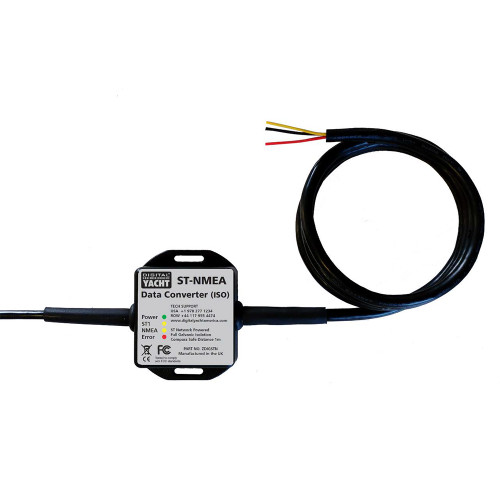
Digital Yacht SeaTalk1 to NMEA Interface | Boat Supply Store
Seamlessly bridge the gap between legacy Raymarine SeaTalk1 equipment and modern NMEA 0183 navigation systems with this essential interface. It provides robust bi-directional data conversion, allowing older devices to communicate with contemporary plotters and autopilots. Leveraging SeaTalk network power and featuring opto-isolated NMEA 0183 input and differential output, this unit ensures reliable data transfer for critical navigational information, proving invaluable for vessels operating on the Intracoastal Waterway or offshore.
Key Features
- Integrate older SeaTalk1 devices with NMEA 0183 systems.
- Achieve bi-directional data flow for complete system communication.
- Utilize direct power from the SeaTalk network, simplifying installation.
- Benefit from opto-isolated NMEA 0183 input for signal integrity.
- Experience reliable differential NMEA 0183 output for robust connections.
- Convert all critical navigational data between protocols.
- Access developer-friendly 'raw data' mode for advanced analysis.
- Expand compatibility with an optional USB version for PC integration.
Specifications
| Product Specifications | |
|---|---|
| Interface Type | Bi-directional SeaTalk1 to NMEA 0183 converter |
| Power Source | SeaTalk network |
| NMEA 0183 Input | Opto-isolated |
| NMEA 0183 Output | Differential |
Who This Is For
This interface is ideal for marine electronics installers and boat owners with mixed SeaTalk1 and NMEA 0183 systems who need to integrate disparate equipment. It also serves developers and advanced users seeking to access raw SeaTalk data or add wireless connectivity to existing systems.
How It Compares
| Feature | Digital Yacht SeaTalk1 to NMEA Interface | Competitor |
|---|---|---|
| Primary Function | SeaTalk1 to NMEA 0183 Bi-directional Conversion | SeaTalk to NMEA 0183 Bi-directional Conversion, NMEA 2000 to NMEA 0183 Bi-directional Conversion |
| SeaTalk1 Compatibility | Yes | Yes, No |
| NMEA 2000 Compatibility | No | No, Yes |
| Developer Raw Data Mode | Yes ($STALK) | No, Yes |
| Power Source | SeaTalk Network | SeaTalk Bus, NMEA 2000 Bus or 12V DC |
Common Concerns Answered
Will this interface work with my specific older Raymarine SeaTalk device?
The Digital Yacht SeaTalk1 to NMEA Interface is designed for SeaTalk1 protocol. Compatibility is generally excellent with most SeaTalk1 devices, but always verify your specific device's protocol to avoid confusion with SeaTalkNG (SeaTalkHS).
Is setting up this interface complicated for someone not familiar with NMEA or SeaTalk?
While basic setup is straightforward, understanding the data flow between protocols is key. For users without prior experience, reviewing the provided manual and considering professional installation is recommended for optimal integration.
What happens if my SeaTalk devices are not compatible?
If your devices use the newer SeaTalkNG (SeaTalkHS) protocol, this interface will not be compatible as it specifically targets the original SeaTalk1 standard.
Frequently Asked Questions
What is the primary function of the Digital Yacht SeaTalk1 to NMEA Interface?
This interface converts data bi-directionally between the proprietary Raymarine SeaTalk1 protocol and the industry-standard NMEA 0183 protocol.
Can this interface send NMEA 0183 data back to a SeaTalk1 device?
Yes, the interface offers robust bi-directional conversion, allowing NMEA 0183 data to be sent back to compatible SeaTalk1 devices.
How is the Digital Yacht SeaTalk1 to NMEA Interface powered?
It draws power directly from the SeaTalk network, eliminating the need for a separate power connection.
What types of navigational data does this interface convert?
It converts all key navigational data, which typically includes GPS position, depth, speed, wind data, and heading information.
Is there a version of this interface available for PC connectivity and accessing raw data?
Yes, a USB version is available, designated by the '$STALK' option, which enables PC, Mac, and embedded system connectivity and offers a special 'raw data' mode for developers.