

Description
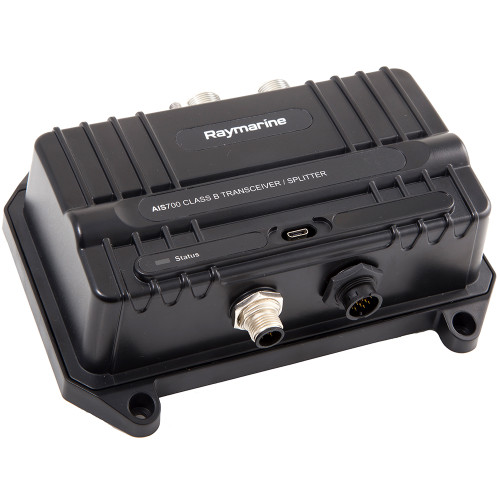
Raymarine AIS700 Class B Transceiver | Boat Supply Store
Navigate with unparalleled certainty using this Class B AIS Transceiver, engineered to broadcast your vessel's identity and receive critical data from other AIS-equipped craft. Its advanced SO-TDMA networking ensures extended range and rapid target acquisition, while the integrated 72-channel GPS receiver provides precise positioning data. Simplify your installation with the built-in VHF antenna splitter, allowing a single antenna to serve both your VHF radio and the AIS700, a crucial consideration for offshore fishing vessels operating in busy shipping lanes.
Key Features
- Transmit and receive full AIS data for complete situational awareness.
- Experience superior range and performance with the latest SO-TDMA networking.
- Simplify installation by utilizing your existing VHF antenna with the built-in splitter.
- Integrate seamlessly with NMEA2000, NMEA0183, PC, and SeaTalkng networks.
- Enhance security with software or hardware switchable Silent Mode.
- Benefit from accurate positioning via the integrated 72-channel GPS receiver.
- Record continuous AIS data for post-voyage analysis using the SD memory slot.
- Benefit from a compact design for flexible and unobtrusive mounting.
Specifications
| Product Specifications | |
|---|---|
| Class | B AIS Transceiver |
| Networking | SO-TDMA |
| GPS Receiver | 72-channel |
| Connectivity | NMEA2000, NMEA0183, PC, SeaTalkng |
| Antenna Splitter | Built-in |
| Silent Mode | Software or hardware switchable |
| Data Recording | SD card slot |
| Programming Requirement | FCC programming required for US sales |
Who This Is For
Sailors, power boaters, and commercial vessels requiring enhanced navigational safety and real-time situational awareness. It is ideal for operators seeking to transmit their position and receive data from other AIS-equipped vessels to avoid collisions.
How It Compares
| Feature | Raymarine AIS700 Class B Transceiver | External Required |
|---|---|---|
| AIS Class | Class B | Class B, Class B |
| Transceiver | Yes | Yes, Yes |
| Built-in Antenna Splitter | Yes | No (External Required), No |
| Built-in GPS Receiver | Yes | Yes, No |
| Networking | NMEA2000, NMEA0183, PC, SeaTalkng | NMEA 2000, NMEA 2000 |
| Silent Mode | Software or hardware switchable | Software switchable, Software switchable |
Common Concerns Answered
The FCC programming requirement for US customers seems complicated. Is there an easy way to handle this?
While FCC programming is mandatory for US sales, it ensures compliance with regulatory standards. Many marine electronics installers or Raymarine dealers can assist with this process, making it a manageable step for many users.
I've heard some AIS systems can be complex to set up. Will I have difficulty with the AIS700?
While the AIS700 offers advanced functionality, Raymarine's integration with their MFDs is generally well-regarded. The built-in antenna splitter simplifies the physical connections, though NMEA2000 network configuration requires some familiarity with marine electronic systems.
Is there a risk of interference with my VHF radio if I use the built-in antenna splitter?
Occasional reports of interference can arise if the antenna system is not optimally configured. Ensuring proper antenna installation, cable integrity, and correct device configuration can mitigate this risk and guarantee clear communication for both your VHF and AIS.
Frequently Asked Questions
What is AIS and why is it essential for safe boating?
AIS (Automatic Identification System) is a maritime transponder system that allows vessels to electronically exchange data, including position, identity, and course. It significantly enhances situational awareness by making your vessel visible to other AIS-equipped ships and aircraft, and vice versa, thereby reducing the risk of collision.
What is the functional difference between Class A and Class B AIS transceivers?
Class A transceivers are mandatory for larger commercial vessels and operate at higher power, offering greater range and faster update rates. Class B transceivers, like the AIS700, are designed for recreational and smaller commercial vessels, providing robust AIS functionality at a lower cost and with reduced power consumption.
Does the Raymarine AIS700 come with its own antenna?
No, the AIS700 does not include its own dedicated antenna. It is designed to share an existing VHF antenna using its integrated VHF antenna splitter, simplifying installation by eliminating the need for a second antenna.
Can I use my current VHF antenna with the AIS700?
Yes, the Raymarine AIS700 features a built-in VHF antenna splitter, allowing it to share your existing VHF antenna. This integrated feature streamlines installation and reduces clutter on your vessel.
What is SO-TDMA technology, and how does it benefit the AIS700?
SO-TDMA (Self-Organizing Time Division Multiple Access) is an advanced networking technology used in Class B+ AIS transceivers. It allows devices to more efficiently manage their transmissions, leading to longer communication range, faster data exchange, and improved target detection, especially in crowded waterways.


