

Description
Blue Sea 7210 15A AC/DC Circuit Breaker | Boat Supply Store
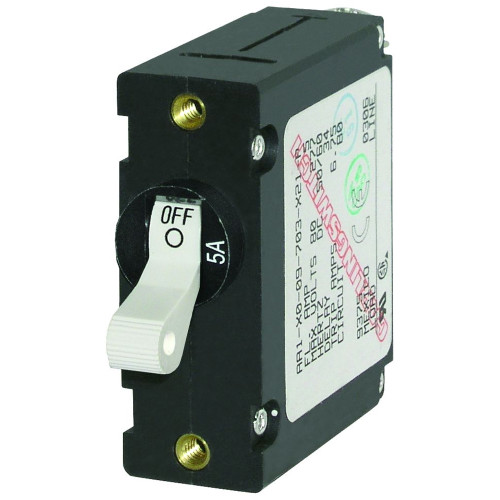
Engineered for critical electrical system protection on vessels operating in demanding marine environments, this single-pole breaker integrates AC/DC switching and overcurrent protection up to 15 Amps. Its 'Trip Free' mechanism ensures continuous protection even when manually held in the ON position during a fault condition. Certified to stringent ABYC, UL 1077, TUV, CE, and CSA standards, it is a reliable choice for offshore fishing boats and coastal cruising yachts requiring certified protection for sensitive electronics.
Key Features
- Integrates switching and circuit protection in one unit
- Single pole Quick Trip models optimized for electronics
- Prevents manual override during fault currents with 'Trip Free' design
- Meets rigorous ABYC Standards for marine safety
- Recognized under UL 1077 for auxiliary protective devices
- Certified by TUV, CE for European markets, and CSA for Canada
- Provides reliable AC/DC protection for versatile electrical systems
- Ensures robust performance in high-vibration marine applications
Specifications
| Product Specifications | |
|---|---|
| Amperage Rating | 15A |
| Poles | Single Pole |
| Type | Magnetic (Quick Trip) |
| AC/DC Capability | AC/DC |
| Delay | Standard |
| Certifications | ABYC Standards, UL 1077 Recognized, TUV Certified, CE marked, CSA Certified |
| Color | White |
Who This Is For
Marine electricians and boat builders seeking certified AC/DC circuit protection for vessel electrical systems. DIY boat owners requiring reliable and compliant safety components for sensitive electronics and primary power distribution.
How It Compares
| Feature | Blue Sea 7210 15A AC/DC Circuit Breaker | Carling Technologies CA1 |
|---|---|---|
| Amperage | 15 Amp | 15 Amp, 5 Amp |
| Poles | Single Pole | Single Pole, Single Pole |
| Type | Magnetic (Quick Trip) | Thermal-Magnetic, Thermal-Magnetic |
| AC/DC Capability | AC/DC | AC/DC, AC/DC |
| ABYC Standards | Meets | Not explicitly stated as a primary feature, Not explicitly stated as a primary feature |
| UL Recognized | UL 1077 | UL 489 (typically for industrial applications), Not explicitly stated |
Common Concerns Answered
Is the 'Quick Trip' magnetic design too sensitive for my engine room circuits?
The 'Quick Trip' magnetic design offers rapid response, ideal for sensitive electronics. If your circuit experiences high inrush current, consider a thermal-magnetic breaker or a higher amperage magnetic breaker to prevent nuisance tripping. Consult your vessel's electrical schematics.
Why is the availability sometimes limited for this specific breaker?
Due to its specialized marine certifications and 'Trip Free' functionality, the Blue Sea 7210 is in high demand for compliant and reliable installations. Advance planning for procurement is recommended for critical projects.
Is this breaker comparable to standard automotive circuit breakers?
No, this breaker is specifically designed and certified for the harsh marine environment, meeting stringent ABYC, UL, TUV, CE, and CSA standards that automotive breakers do not. Its AC/DC capability and 'Trip Free' design offer superior safety and reliability for boats.
Frequently Asked Questions
What is the amperage rating of the Blue Sea 7210 circuit breaker?
The Blue Sea 7210 circuit breaker has an amperage rating of 15 Amps.
Is this circuit breaker suitable for both AC and DC applications?
Yes, the Blue Sea 7210 is designed for both AC and DC applications, offering versatile protection for a boat's electrical systems.
What certifications does the Blue Sea 7210 circuit breaker hold?
The Blue Sea 7210 circuit breaker holds multiple certifications including ABYC Standards, UL 1077 Recognized, TUV Certified, CE marked for Europe, and CSA Certified for Canada.
What does 'Trip Free' design mean for this circuit breaker?
A 'Trip Free' design means the circuit breaker cannot be held in the ON position when a fault condition or overload is present, ensuring the circuit is always interrupted for safety.
What is the purpose of a magnetic circuit breaker compared to a thermal one?
A magnetic circuit breaker primarily responds to sudden, high overcurrents (short circuits) instantaneously, which is beneficial for protecting sensitive electronics. Thermal circuit breakers respond to prolonged overloads by heating up, offering a standard delay. This model combines the benefits of a magnetic trip with AC/DC capability and marine certifications.