

Description
Garmin B619 Bronze Transducer 8-Pin | Boat Supply Store
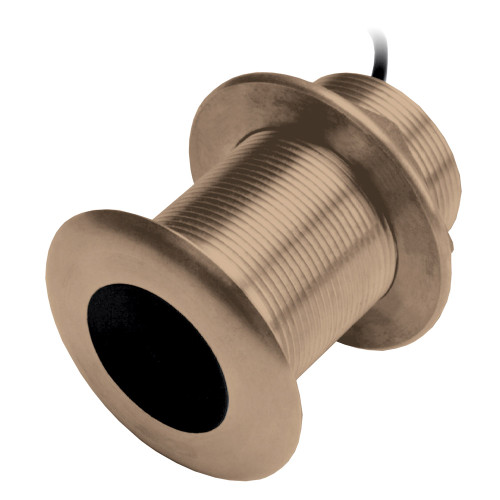
Designed for cruising powerboats and sailboats with hull deadrise between 16° and 24°, this Garmin transducer ensures accurate vertical beam targeting for precise depth readings. It offers deep echosounding capabilities up to 206 meters (700 feet) and a near-flush installation that minimizes hull drag. The bronze housing provides robust durability for saltwater environments, and the fixed 20° tilt is engineered to compensate for hull angles, maintaining optimal sonar performance across varied hull designs.
Key Features
- Minimizes hull drag with a low-profile design
- Achieve deep echosounding up to 206M (700')
- Built for durability with a robust bronze housing
- Compensates for hull angles 16° to 24° with a fixed 20° tilt
- Optimizes cable routing and protection with a right-angle exit
- Adapts to irregular hull surfaces with an included rubber washer
- Ensures compliance with ABYC H-27 standards
- Provides optional temperature sensing capabilities
Specifications
| Product Specifications | |
|---|---|
| Connector Type | 8-pin |
| Depth Only or Depth and Temperature | Depth only or depth and temperature |
| Max Depth | 206M (700') |
| Hull Deadrise | 16°-24° |
| Housing Material | Bronze |
| ABYC Compliance | H-27 compliant |
| Boat Size | Up to 9M (30') |
| Cable Exit Angle | Right-angle |
Who This Is For
This transducer is ideal for powerboat and sailboat owners with hulls featuring a 16° to 24° deadrise angle. It is suited for boaters seeking reliable depth detection with minimal underwater obstruction and a durable, low-profile installation.
How It Compares
| Feature | Garmin B619 Bronze Transducer 8-Pin | Smart |
|---|---|---|
| Housing Material | Bronze | Bronze, Plastic |
| Connector Type | 8-pin | 8-pin, Raymarine Element/Axiom/eS/gS |
| Fixed Tilt | 20° | 20°, Variable |
| Max Depth | 206M (700') | 1500' (457m), 300' |
| Hull Deadrise Range | 16°-24° | 16°-24°, Variable |
| Integrated Speed Sensor | No | No, Yes |
Common Concerns Answered
Why might some users desire a greater depth range than this transducer offers?
While this transducer provides a capable 700-foot depth range suitable for most cruising and nearshore applications, users operating in significantly deeper offshore environments or requiring detailed bathymetric surveys may prefer transducers with extended depth capabilities up to 1500 feet or more.
What if I need integrated speed sensing for my vessel?
This Garmin B619 transducer is designed exclusively for depth and optional temperature readings; it does not include an integrated speed sensor. For combined speed and depth data from a single thru-hull unit, alternative models with integrated speed sensors would be necessary.
Is this transducer compatible with non-Garmin marine electronics?
No, the Garmin B619 transducer utilizes an 8-pin connector specifically designed to interface with compatible Garmin display units. Integration with displays from other manufacturers is not supported due to proprietary signaling and connector standards.
Frequently Asked Questions
What is the maximum depth range of the Garmin B619 transducer?
The Garmin B619 transducer has a maximum depth range of 206 meters, which is equivalent to 700 feet.
What hull deadrise angles is the Garmin B619 20° tilt transducer designed for?
The 20° tilt is specifically designed to compensate for hull deadrise angles ranging from 16° to 24°.
Is the Garmin B619 transducer suitable for sailboats?
Yes, the Garmin B619 transducer is suitable for sailboats with hull deadrise angles between 16° and 24°, offering accurate depth readings with minimal drag.
What is the purpose of the 20° tilt in the Garmin B619 transducer?
The 20° tilt is incorporated to ensure the transducer beam is directed vertically into the water column, compensating for the vessel's hull angle and providing accurate depth readings on boats with moderate deadrise.
What material is the Garmin B619 transducer housing made of?
The Garmin B619 transducer features a durable housing constructed from bronze, which offers excellent corrosion resistance, particularly in saltwater environments.