

Description
Pacer 14/3 AWG Triplex Cable | Boat Supply Store
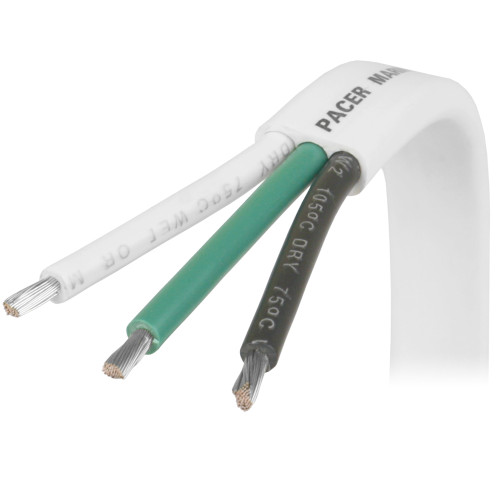
This 14 AWG, 3-conductor Pacer triplex cable is engineered for demanding AC circuit applications within marine environments, offering a robust solution for onboard power distribution systems. Constructed with finely stranded tinned copper conductors and a specialized PVC insulation, it ensures superior flexibility and corrosion resistance, crucial for applications like powering galley appliances or navigation equipment on offshore vessels. Rated for 600V and compliant with UL Standard 1426 and ABYC E-11.16, this 500-foot roll provides a reliable and durable wiring solution that resists acid, alkali, abrasion, flame, gasoline, oil, and moisture.
Key Features
- Corrosion Resistance: Finely stranded tinned copper conductors prevent galvanic corrosion.
- Superior Flexibility: Specialized PVC insulation and talcum powder coating facilitate easy bending and routing.
- Moisture Protection: Extrusion process eliminates voids in insulation, preventing moisture and air ingress.
- Durability: Tough PVC insulation offers excellent resistance to abrasion, oil, gasoline, and flame.
- Ease of Installation: Talcum powder coating allows for straightforward jacket removal during termination.
- Clear Identification: Color-coded conductors simplify circuit identification and troubleshooting.
- High Voltage Rating: Rated for 600V, suitable for a wide range of marine electrical systems.
- Marine Compliance: Meets stringent UL Standard 1426, U.S.C.G. 33 CFR part 183, and ABYC E-11.16 requirements.
Specifications
| Product Specifications | |
|---|---|
| Gauge | 14 AWG |
| Conductor Count | 3 |
| Cable Type | Triplex |
| Conductor Material | Stranded Tinned Copper |
| Insulation Material | Specialized PVC |
| Jacket Shape | Flat |
| Voltage Rating | 600V |
| Resistance Properties | Acid, Alkali, Abrasion, Flame, Gasoline, Oil, Moisture |
| Length | 500' |
| Color Coding | Black/Green/White |
Who This Is For
Marine electricians and boat owners requiring durable, flexible, and highly resistant AC circuit wiring for onboard systems. RV enthusiasts also benefit from its robust construction for reliable power distribution.
How It Compares
| Feature | Pacer 14/3 AWG Triplex Cable | Ancor Marine Grade 14 AWG Duplex Boat Cable |
|---|---|---|
| Number of Conductors | 3 | 2 |
| Conductor Material | Stranded, Tinned Copper | Tinned Copper |
| Insulation Material | Flexible, Color-Coded PVC | PVC |
| Voltage Rating | 600-V | 600V |
| Jacket Shape | Flat | Round |
| Length | 500' | Typically less capable |
Common Concerns Answered
Is this cable available in shorter lengths for smaller projects?
While this specific product is packaged in a 500' length, Pacer and other marine electrical brands often offer shorter lengths of comparable 14 AWG wire for smaller DIY applications. Please check our listings for alternative sizes if a full 500' roll exceeds your project requirements.
Why is this marine-grade cable more expensive than standard household wire?
The higher initial cost is attributed to the specialized construction essential for marine environments: tinned copper conductors for superior corrosion resistance, a more robust PVC insulation compound with advanced extrusion processes, and adherence to rigorous marine safety certifications like UL 1426 and ABYC E-11.16. This ensures long-term reliability and safety, mitigating the higher costs associated with premature failure in harsh, wet conditions.
What if I need a different number of conductors?
This product is a 3-conductor triplex cable designed for circuits requiring hot, neutral, and ground. If your application necessitates only two conductors (hot and neutral), Pacer and other marine-grade manufacturers offer duplex cables which may be more suitable. Please consult our electrical wire catalog for other conductor configurations.
Frequently Asked Questions
What is 14/3 AWG Triplex cable commonly used for on a boat?
14/3 AWG Triplex cable is commonly used for circuits requiring a hot, neutral, and ground conductor, such as powering AC outlets for appliances in the galley, cabin lights, or shore power inlets on vessels up to approximately 40 feet. It's also suitable for running power to bilge pumps with integral float switches or other AC-powered equipment requiring a dedicated ground.
What makes Pacer's triplex cable flexible and corrosion-resistant?
Pacer achieves superior flexibility and corrosion resistance through the use of finely stranded tinned copper conductors, which are less prone to oxidation and degradation in saltwater environments, and a specialized PVC insulation process combined with a talcum powder coating on the individual wires. This combination allows for easier bending during installation and maintains flexibility over time, even with constant vibration and temperature fluctuations.
What type of insulation does this Pacer triplex cable use and what are its benefits?
This Pacer triplex cable utilizes a specialized, tough PVC insulation. Its benefits include excellent resistance to abrasion, oil, gasoline, flame, and moisture, all critical factors for durability in demanding marine applications. The extrusion process specifically fills all voids, preventing moisture and air from compromising the conductor's integrity.
Is this cable suitable for use in wet marine environments?
Yes, this cable is specifically designed and rated for wet marine environments. Its specialized PVC insulation, void-free extrusion, and tinned copper conductors provide robust protection against moisture ingress and galvanic corrosion, making it ideal for bilge areas, engine rooms, and exposed deck areas.
What are the key features of Pacer's 14/3 AWG Triplex Cable?
Key features include finely stranded tinned copper conductors for superior corrosion resistance and flexibility, tough PVC insulation engineered for moisture and fatigue protection, a void-filling extrusion process to prevent internal contamination, a talcum powder coating for easy jacket removal, and color-coded conductors for straightforward identification. It is also compliant with UL Standard 1426, U.S.C.G. 33 CFR part 183, and ABYC E-11.16.
