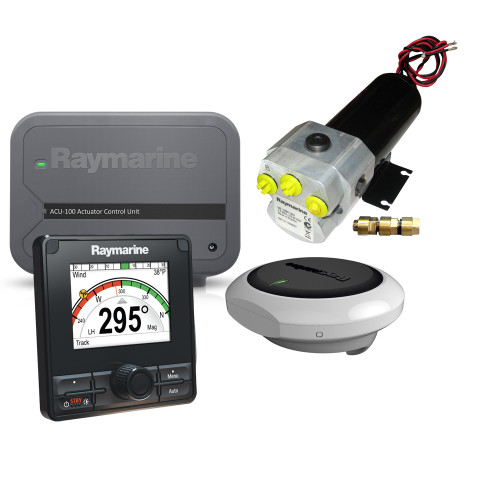


Description
Raymarine EV-100 Wheel Autopilot | Boat Supply Store
Navigate offshore passages with precision using the Raymarine EV-100 Wheel Evolution Autopilot, designed to provide superior course-holding for sailboats up to 16,500 lbs. Its integrated EV-1 Sensor Core utilizes 9-axis monitoring for exceptional stability and responsiveness, while the p70s control head offers intuitive operation with the LightHouse user interface. This system features a robust wheel drive and a SeaTalkng network for efficient data and power distribution, ensuring reliable performance across a 12V DC system.
Key Features
- Superior Performance with Evolution Ai technology for intelligent course stabilization.
- No Calibration Required for immediate deployment straight out of the box.
- Quick and Easy Installation with a user-friendly, integrated wheel drive mechanism.
- Universal Wheel Fitment compatible with most types of sailboat wheels.
- Robust Clutch Engagement ensuring reliable and secure drive connection.
- Advanced 9-axis Monitoring from the EV Sensor Core for precise motion sensing.
- Intuitive Control via the p70s Autopilot Control Head featuring the LightHouse user interface.
- Integrated System Power with the ACU-100 providing drive power and SeaTalkng bus power.
Specifications
| Product Specifications | |
|---|---|
| Autopilot Type | Wheel Drive |
| Max Boat Weight | 16,500 lbs (7,500 kg) |
| System Voltage | 12V DC |
| EV Sensor Core Rating | IPX6/IPX7 waterproof |
| Networking | SeaTalkng |
Who This Is For
Sailboat owners with wheel steering systems and vessels weighing up to 16,500 lbs (7,500 kg) seeking a high-performance, easy-to-install autopilot. It is ideal for those who value intuitive operation and advanced sensing technology for confident navigation.
How It Compares
| Feature | Raymarine EV-100 Wheel Autopilot | Competitor |
|---|---|---|
| Autopilot Type | Wheel Drive | Hydraulic |
| Max Boat Displacement | 16,500 lbs (7,500 kg) | 30,000 lbs |
| Sensor Technology | 9-axis EV Sensor Core | 3-axis Gyro/Accelerometer |
| Installation Complexity | Quick and easy, integrated wheel drive | Requires hydraulic pump installation |
Common Concerns Answered
What if I encounter issues with the SeaTalkng cable connections?
Occasional issues with SeaTalkng cable connections can typically be resolved by ensuring the cables are securely seated. A firm reseating of the connectors often restores proper data and power flow.
Is the advanced functionality difficult to learn?
While the core operation is straightforward, some users report a slight learning curve for advanced features or complex integration with other onboard electronics. Consulting the installation manual and Raymarine's support resources can facilitate a smoother learning process.
Is the wheel drive mechanism noisy?
Some users have reported that the wheel drive mechanism can produce audible noise during operation. This is a characteristic of this type of drive system and may vary in perception among users.
Frequently Asked Questions
What is the maximum boat weight the Raymarine EV-100 Wheel Evolution Autopilot can handle?
The Raymarine EV-100 Wheel Evolution Autopilot is designed to handle sailboats up to a maximum displacement of 16,500 lbs (7,500 kg).
Does the EV-100 Wheel Evolution Autopilot require calibration?
No, a significant advantage of the Evolution Ai technology is that it offers a no-calibration, quick-install design, allowing for immediate use after installation.
What types of sailboat wheels is this autopilot compatible with?
This autopilot system is designed to fit most types of sailboat wheels, offering broad compatibility for various wheel steering configurations.
What is included in the Raymarine EV-100 Wheel Evolution Autopilot kit?
The kit is a complete autopilot-in-a-box and includes the EV-1 Sensor Core, the p70s Autopilot Control Head, the ACU-100 Actuator Control Unit, and the Wheel Drive unit.
What is the power requirement for the EV-100 Wheel Evolution Autopilot?
The Raymarine EV-100 Wheel Evolution Autopilot operates on standard 12V DC marine electrical systems.