

Description
Samlex 30A Flush Mount Solar Charge Controller w/LCD | Boat Supply Store
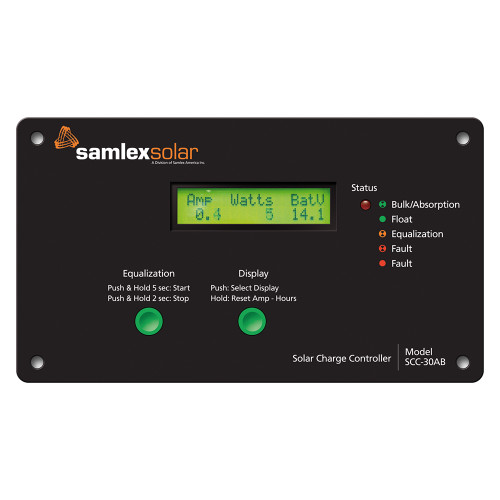
Maintain optimal battery health for auxiliary systems on your catamaran or offshore fishing vessel with this 30A PWM solar charge controller. It facilitates 4-stage charging across Bulk, Absorption, Float, and Equalization cycles, ensuring your deep-cycle batteries are consistently maintained. The unit's compact 7.5 x 4.25 x 1.5-inch footprint allows for discreet flush mounting, and its 12V/24V input compatibility supports diverse marine electrical configurations.
Key Features
- Pulse Width Modulated (PWM) charging for efficient solar energy conversion.
- 4-stage battery charging (Bulk, Absorption, Float, Equalization) for superior battery longevity.
- 8 selectable battery charging profiles to precisely match various battery chemistries.
- Digital LCD Monitor provides clear, real-time system status.
- Temperature compensated charging (with optional sensor) for optimal performance in fluctuating ambient temperatures.
- Flush mount design integrates cleanly into vessel panels or enclosures.
- 30 Amp maximum charge current capability.
- 12V/24V system voltage compatibility.
Specifications
| Product Specifications | |
|---|---|
| Amp Rating | 30 Amp |
| System Voltage | 12V/24V |
| Charging Technology | PWM |
| Battery Charging Stages | 4-stage |
| Selectable Profiles | 8 |
| Display | LCD |
| Weight | 0.8 lbs (0.36 kg) |
| Dimensions | 7.5 x 4.25 x 1.5 inches (19.1 x 10.8 x 3.8 cm) |
| Warranty | 5-year limited |
Who This Is For
RV owners, service vehicle operators, boaters, field workers, telecommunications professionals, mobile office users, and construction site managers who need reliable battery charging and protection for their off-grid or mobile power systems.
How It Compares
| Feature | Samlex 30A Flush Mount Solar Charge Controller w/LCD | Competitor |
|---|---|---|
| Charging Technology | PWM | MPPT |
| Max Charge Current | 30A | 30A |
| Battery Voltage | 12V/24V | 12/24/48V, 12/24V |
| Display | Digital LCD Monitor | LCD |
Common Concerns Answered
Is the setup for the 8 charging profiles straightforward?
While the 8 charging profiles offer precise control, users may find it beneficial to consult the manual for detailed setup guidance. The clear LCD display aids in navigating the options once understood.
Does the battery temperature sensor come included?
The battery temperature sensor is an optional accessory and is not included with the Samlex SCC-30AB. Purchasing this sensor separately ensures optimal charging performance by automatically adjusting for ambient temperature variations.
Why choose PWM over MPPT?
PWM controllers like the Samlex SCC-30AB offer a cost-effective and reliable solution for many marine applications where panel voltage closely matches battery voltage, providing robust charging without the higher initial investment of MPPT technology.
Frequently Asked Questions
What is the maximum solar input for the Samlex SCC-30AB?
The Samlex SCC-30AB is designed to manage a 30 Amp solar array. For precise input voltage limits, please refer to the product manual.
Can the Samlex SCC-30AB be used with different battery types?
Yes, the Samlex SCC-30AB features 8 selectable charging profiles to accommodate various battery types, including lead-acid and potentially some lithium chemistries depending on their charging requirements.
Does the Samlex SCC-30AB have overcharge protection?
Yes, the 4-stage charging system (Bulk, Absorption, Float, Equalization) inherently provides overcharge protection by managing the battery's state of charge effectively and preventing damage from excessive voltage.
What is the warranty period for the Samlex SCC-30AB?
The Samlex SCC-30AB comes with a 5-year limited warranty, providing assurance of its durability and performance for your marine electrical system.
Is a battery temperature sensor required for the Samlex SCC-30AB?
A battery temperature sensor is not strictly required for operation, but it is highly recommended for optimal charging performance, especially in environments with significant temperature fluctuations, as it allows for temperature compensation.

