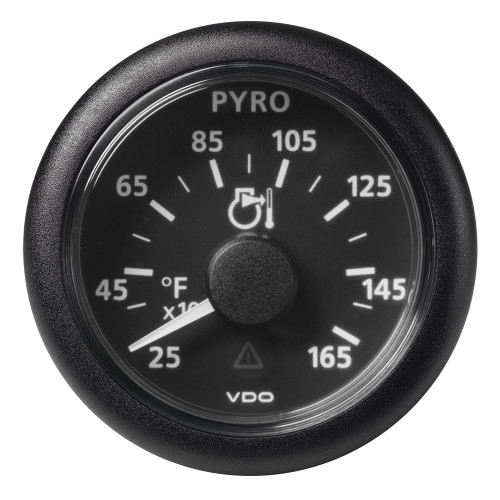


Description
Veratron Pyrometer Sensor 100-900C | Boat Supply Store
Maintain precise control over high-temperature exhaust gas and fluid systems with this pyrometer sensor, capable of accurately measuring between 100-900°C (250-1650°F). It features a durable R 1/4" Male thread for secure installation and integrates seamlessly via NMEA 2000® for digital data transmission to your vessel's instrumentation. This sensor is engineered for reliable monitoring of exhaust gas, coolant, water, air, engine oil, transmission oil, and fuel.
Key Features
- Accurate measurement of exhaust gas, coolant, water, air, engine oil, transmission oil, and fuel temperatures.
- Extensive temperature range from 100-900°C (250-1650°F).
- Simplified plug-and-play installation and configuration process.
- Seamless integration with NMEA 2000® certified networks.
- Adjustable sender element length up to 60 mm for versatile placement.
- Secure mounting via durable R 1/4" Male thread.
- Broad operating voltage compatibility from 6-24 VDC.
- Reliable thermocouple sensing element for consistent performance.
Specifications
| Product Specifications | |
|---|---|
| Temperature Range | 100-900°C (250-1650°F) |
| Input Signal | LIN bus |
| Operating Voltage | 6-24 VDC |
| Sensor Element | Thermocouple |
| Output Signal | Analog (0-37 MV TCS) |
| Sensor Connector | Ring Tongue |
| Thread Size | R 1/4" Male |
| Adjustable Sender Element Length | Up to 60 mm |
| Sensor Diameter | 6 mm |
| Torque Specification | 20 Nm |
Who This Is For
Marine engine technicians and boat owners requiring granular temperature data for performance optimization and early fault detection. System integrators can leverage its NMEA 2000® certification for robust instrumentation upgrades.
How It Compares
| Feature | Veratron Pyrometer Sensor 100-900C | Competitor |
|---|---|---|
| Temperature Range | 100-900°C / 250-1650°F | Up to 1500°F (815°C), Up to 1650°F |
| NMEA 2000® Certification | Certified | No, No |
| Input Signal | LIN bus | Analog, Analog |
| Thread Size | R 1/4" Male | 1/8" NPT, 1/8" NPT |
Common Concerns Answered
What is a pyrometer sensor used for on a boat?
A pyrometer sensor monitors high temperatures, primarily exhaust gas temperatures in marine engines, which is critical for performance tuning, preventing overheating, and diagnosing potential engine issues before they become severe failures.
What if I have an older system and need NMEA 2000® integration?
While this sensor is NMEA 2000® certified, direct integration with older systems might require a compatible gateway module. Veratron offers solutions like their LinkUp Gateway Module, which facilitates this bridge. Consult the LinkUp Gateway Module manual for specific compatibility details.
Is the initial setup complicated?
The initial setup requires a basic understanding of marine electrical systems and proper thread installation. For NMEA 2000® integration, familiarity with gateway configurations is beneficial, though the plug-and-play nature of the sensor itself simplifies the process.
Frequently Asked Questions
How does the Veratron Pyrometer Sensor connect to my boat's systems?
This sensor utilizes a LIN bus input signal and provides an Analog signal output (0-37 MV TCS). For full NMEA 2000® network integration, it is typically connected through a compatible gateway module.
What is the temperature measurement range of the Veratron Pyrometer Sensor?
The sensor accurately measures temperatures within a range of 100°C to 900°C, which is equivalent to 250°F to 1650°F.
Is the Veratron Pyrometer Sensor compatible with NMEA 2000® networks?
Yes, the Veratron Pyrometer Sensor is NMEA 2000® certified, ensuring seamless integration with standard NMEA 2000® marine electronic networks.
What types of fluids or gases can this sensor measure temperature for?
This versatile sensor is designed for monitoring exhaust gas, coolant, water, air, engine oil, transmission oil, and fuel temperatures.
What are the physical mounting specifications?
The sensor features a durable R 1/4" Male thread for mounting, with an adjustable sender element length up to 60 mm and a sensor diameter of 6 mm. It requires a torque specification of 20 Nm for secure installation.