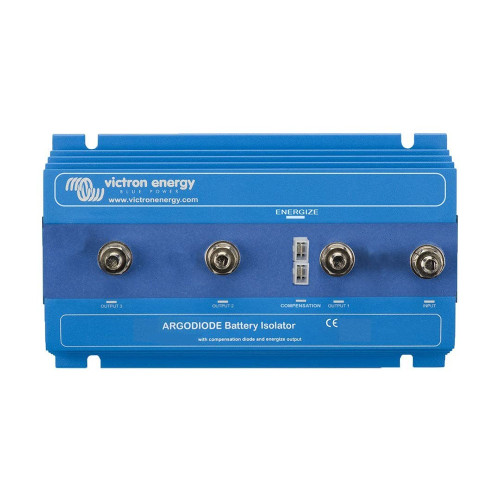


Description
Victron Argo FET Isolator 200A 3 Batt | Boat Supply Store
This advanced isolator efficiently manages charging across three separate batteries from a single alternator or charger, crucial for maintaining optimal battery health and performance on a sportfishing boat in the Gulf Coast. It utilizes Field-Effect Transistor (FET) technology to achieve an exceptionally low voltage drop, averaging only 0.1V at higher currents, significantly reducing power loss compared to traditional diode isolators. With a robust 200 Amp continuous current rating, it ensures reliable power distribution for demanding marine applications.
Key Features
- Virtually zero voltage loss for superior charging efficiency
- Simultaneously charge multiple batteries from a single source
- Prevents parasitic discharge between batteries
- 200 Amp continuous current rating for high-demand systems
- Optimizes battery lifespan through consistent charging
- Compact and reliable FET technology
- Supports up to 3 individual battery banks
- Minimizes power wastage from alternator or charger
Specifications
| Product Specifications | |
|---|---|
| Brand | Victron Energy |
| Model | Argo FET 200-3 |
| Number of Batteries | 3 |
| Max Continuous Current Rating | 200 Amp |
| Voltage Drop (Low Current) | < 0.02V |
| Voltage Drop (Average High Current) | 0.1V |
Who This Is For
Boat owners and marine professionals requiring efficient multi-battery charging solutions without compromising voltage integrity. Ideal for vessels with complex electrical systems needing to ensure optimal battery performance and longevity.
How It Compares
| Feature | Victron Argo FET Isolator 200A 3 Batt | Competitor |
|---|---|---|
| Technology | FET (Field-Effect Transistor) | Automatic Charging Relay (ACR), Voltage Sensitive Relay |
| Max Continuous Amps | 200A | 500A, 100A |
| Number of Batteries Supported | 3 | 2, 4 |
| Voltage Drop (Avg. High Current) | 0.1V | Varies (ACR technology typically has higher drop than FET), Varies |
Common Concerns Answered
Is warranty support easily accessible?
While direct manufacturer warranty access can sometimes be challenging, purchasing from BoatSupplyStore.com ensures streamlined support channels for all Victron Energy products, providing confidence in your investment.
Is installation complicated?
Installation requires a basic understanding of DC marine electrical systems, including proper wiring and fusing. For users unfamiliar with these procedures, professional marine electrical installation is strongly recommended to ensure safety and correct functionality.
Is the initial cost higher than other isolators?
The Victron Argo FET Battery Isolator 200-3 represents an investment in superior technology and performance, offering significant advantages in efficiency and battery longevity over basic diode isolators. This advanced capability justifies the price point for critical marine electrical systems.
Frequently Asked Questions
What is the voltage drop of the Victron Argo FET Battery Isolator 200-3?
The Victron Argo FET Battery Isolator 200-3 exhibits extremely low voltage drop, typically less than 0.02V at low current and averaging around 0.1V at higher currents.
How many batteries can the Victron Argo FET Battery Isolator 200-3 charge simultaneously?
This model is designed to support and charge up to three separate batteries simultaneously from a single charging source.
What is the maximum current rating for the Victron Argo FET Battery Isolator 200-3?
The Victron Argo FET Battery Isolator 200-3 has a maximum continuous current rating of 200 Amps.
What is the difference between a FET battery isolator and a diode battery isolator?
FET battery isolators, like the Victron Argo FET, use Field-Effect Transistors which result in significantly lower voltage drop and power loss compared to traditional diode isolators. This leads to more efficient charging and better battery health.
Does the Victron Argo FET Battery Isolator 200-3 require external power?
No, the Victron Argo FET Battery Isolator 200-3 does not require external power for its operation. It functions passively by managing the current flow from the charging source to the batteries.