
Description
Wichard 4-3/4" Snap Shackle w/Swivel Eye | Boat Supply Store
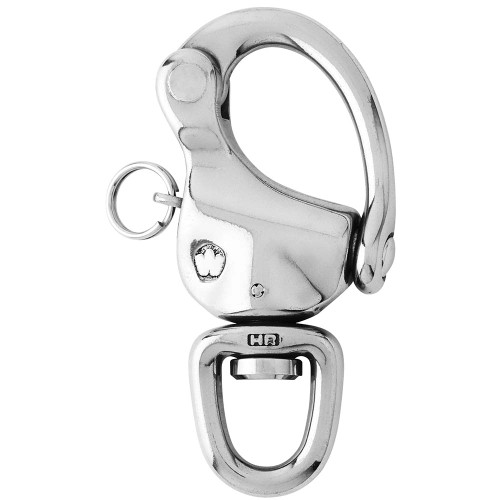
Engineered for demanding marine environments, this Wichard snap shackle provides exceptional strength and operational reliability for critical sail control and rigging applications. Its HR Forged Grade 17.4 PH stainless steel construction offers superior corrosion resistance and load-bearing capacity, with a substantial 4-3/4" size accommodating multiple attachments. The integrated swivel eye ensures free rotation, optimizing sail trim and orientation, while the captive plunger pin prevents accidental detachment, enhancing safety on deck.
Key Features
- HR Forged Grade 17.4 PH stainless steel for exceptional strength and durability
- Captive plunger pin ensures pin remains attached, preventing loss
- Free-rotating swivel eye optimizes sail orientation and trim
- Large attachment eye accepts multiple rope or line connections
- High working and breaking loads suitable for rigorous marine use
- Corrosion-resistant Grade 17.4 PH stainless steel for saltwater environments
- Easy to operate with an option for lanyard attachment
- Optimized for demanding sailing applications requiring reliable hardware
Specifications
| Product Specifications | |
|---|---|
| Length | 4-3/4" |
| Material | HR Forged Grade 17.4 PH Stainless Steel |
| Swivel Eye | Yes |
| Captive Pin | Yes |
Who This Is For
Sailors and marine enthusiasts requiring a robust, reliable, and versatile snap shackle for diverse sailing applications. Ideal for those who benefit from free rotation for precise sail trim and orientation in demanding conditions.
How It Compares
| Feature | Wichard 4-3/4" Snap Shackle w/Swivel Eye | Competitor |
|---|---|---|
| Material | Grade 17.4 PH Stainless Steel | 316 Stainless Steel |
| Size | 4-3/4" | 4-1/4", 4" |
| Swivel Eye | Yes | Yes |
| Captive Pin | Yes | Yes |
Common Concerns Answered
Is the price justified for this snap shackle?
The higher price point is directly attributable to the use of superior HR Forged Grade 17.4 PH stainless steel and advanced manufacturing processes, offering enhanced durability and load capacity. This investment ensures long-term reliability in harsh marine environments, mitigating potential failure risks.
Are there common issues with this specific model?
No significant complaints have been identified for the Wichard 4-3/4" Snap Shackle w/Swivel Eye. Occasional user error relates to selecting an incorrect size for their specific rigging setup, highlighting the importance of verifying dimensions against application needs.
What is the general customer sentiment for Wichard shackles?
Customer sentiment is highly positive, frequently citing the exceptional durability, unwavering reliability, and superior performance that Wichard products deliver even in the most demanding marine conditions.
Frequently Asked Questions
What is the working load limit of the Wichard 4-3/4" Snap Shackle w/Swivel Eye?
Detailed working load limit (WLL) and breaking load data are available on the product's technical specification sheet, not directly provided in this summary. Consult the manufacturer's data for precise load ratings.
What type of stainless steel is used in the Wichard 4-3/4" Snap Shackle w/Swivel Eye?
This Wichard snap shackle is constructed from HR Forged Grade 17.4 PH stainless steel, a high-strength alloy renowned for its excellent mechanical properties and corrosion resistance.
Can the plunger pin on this snap shackle be detached?
No, the plunger pin on this Wichard snap shackle is captive and designed to remain attached to the shackle body, preventing accidental loss during use.
What are the primary applications for this snap shackle?
Primary applications include attaching sails, halyards, sheets, and other running rigging components in sailing yachts and dinghies. Its swivel eye makes it particularly useful for applications requiring rotational freedom.
How does the swivel eye benefit sail orientation?
The free-rotating swivel eye allows the shackle to pivot independently of the load, preventing line twisting and enabling the attached sail to achieve optimal orientation relative to the wind, thereby improving sail trim and performance.