
Description
Garmin Airmar Smart Depth/Temp Transducer NMEA 2000 | Boat Supply Store
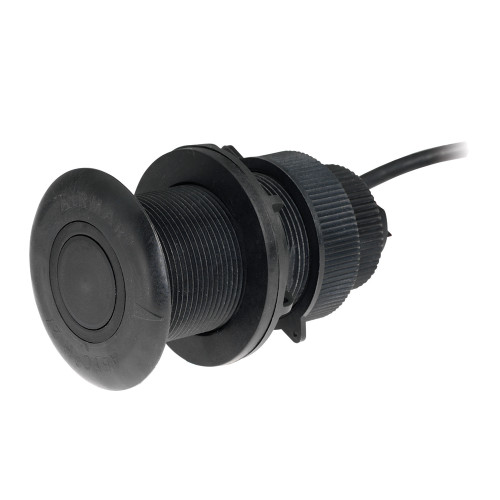
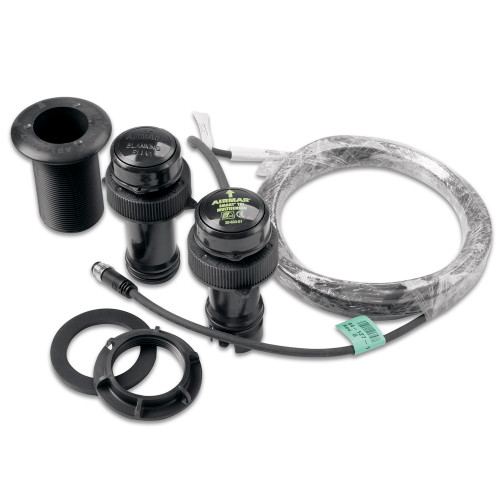
This Garmin Airmar Smart Sensor DT800 integrates crucial depth and temperature sensing capabilities into your vessel's NMEA 2000 network, simplifying data distribution. Engineered for hulls with a 16-24 degree deadrise, it provides accurate readings up to 600 feet utilizing a 235 kHz operating frequency and a 12-degree beamwidth. Its compact, thru-hull design minimizes underwater obstruction and streamlines installation for a clean integration on vessels operating in coastal or offshore environments.
Key Features
- Smart Thru-Hull Mount Transducer for integrated performance.
- Provides precise Depth and Temperature Data for critical navigation.
- NMEA 2000® Network Compatible for seamless integration with other marine electronics.
- 100 W Power Output ensuring reliable signal transmission and reception.
- 600 ft Depth Capability for comprehensive underwater surveying.
- 235 kHz Operating Frequency optimized for shallow to moderate water depths.
- 12 Degree Beamwidth offering focused underwater detection.
- 16 to 24 Degree Deadrise compatibility for specific hull designs.
Specifications
| Product Specifications | |
|---|---|
| Transducer | Plastic thru-hull mount |
| Sensors | Depth and temperature |
| Power | 100W |
| Max Depth | 600 ft |
| Frequency | 235 kHz |
| Beamwidth | 12 degrees |
| Deadrise | 16-24 degrees |
| Network | NMEA 2000® compatible |
Who This Is For
Boaters requiring precise depth and temperature data integrated into their NMEA 2000 network, particularly those operating vessels with hull deadrise angles between 16 and 24 degrees.
How It Compares
| Feature | Garmin Airmar Smart Depth/Temp Transducer NMEA 2000 | Competitor |
|---|---|---|
| Depth Capability | 600 ft | — |
| Operating Frequency | 235 kHz | 235 kHz, 235 kHz |
| Beamwidth | 12 degrees | 20 degrees, 20 degrees |
| Deadrise Range | 16-24 degrees | 0-22 degrees, 0-22 degrees |
| Power Output | 100 W | 300W, 300W |
| Network Compatibility | NMEA 2000® | NMEA 2000®, Raymarine RayNet / NMEA 2000® |
Common Concerns Answered
Installation challenges have been noted. What is the recommended approach?
While installation requires drilling a thru-hull opening and precise sealing, a 3/5 difficulty rating suggests basic DIY skills suffice. Careful adherence to the provided manual and instructions is paramount. For those uncertain about hull penetrations, professional marine installation is strongly advised to ensure watertight integrity and optimal sensor performance.
Can signal interference occur with this transducer?
Signal interference is a possibility if the transducer is not installed correctly or if other active marine electronics are situated in close proximity. Proper placement, away from sources of electromagnetic interference, and meticulous installation are critical to achieving clean, reliable data transmission.
Is this transducer suitable for all boat hulls?
This specific Garmin Airmar Smart Sensor is designed for hulls with a deadrise angle between 16 and 24 degrees. Vessels outside this range may require a different transducer model to ensure accurate depth readings and proper beam alignment with the seabed.
Frequently Asked Questions
What is the maximum depth this transducer can measure?
The Garmin Airmar Smart Sensor DT800 is capable of measuring depths up to 600 feet.
What is the operating frequency of the Garmin Airmar DT800 transducer?
The operating frequency of the Garmin Airmar DT800 transducer is 235 kHz.
What type of network does this transducer connect to?
This transducer connects to a NMEA 2000® network, allowing for seamless integration with compatible marine electronics.
What is the beamwidth of the DT800 transducer?
The DT800 transducer has a beamwidth of 12 degrees, providing a focused cone for depth detection.
Does this transducer measure water temperature?
Yes, in addition to depth, the Garmin Airmar Smart Sensor DT800 also measures water temperature.