
Description
ProMariner 70A 2-Alt/3-Batt Isolator | Boat Supply Store
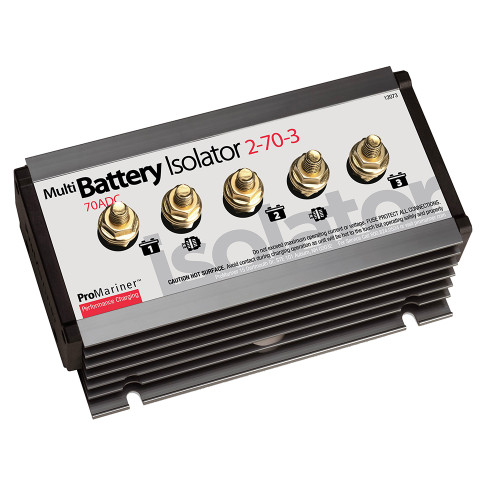
For vessels operating with multiple battery banks and dual alternators, this ProMariner 12073 unit effectively manages simultaneous charging. It separates up to two alternator outputs, directing current to three distinct battery banks, preventing parasitic drain between them. Engineered with gold-plated terminals, it ensures superior conductivity and resistance to galvanic corrosion, enhancing the overall charging efficiency and lifespan of your battery array.
Key Features
- Independent dual alternator charging management
- Optimized power distribution to three battery banks
- High-capacity 70 AMP continuous rating
- Corrosion-resistant gold-plated terminal connectivity
- Enhanced charging efficiency for full battery states
- Prevents unwanted battery discharge between banks
- Robust build for demanding marine environments
- Facilitates dedicated charging for starting and house batteries
Specifications
| Product Specifications | |
|---|---|
| Amperage Rating | 70 AMP |
| Alternator Input | 2 |
| Battery Output | 3 |
| Terminal Type | Gold-plated |
Who This Is For
Boat owners with dual alternator systems requiring independent charging of three separate battery banks will benefit from this isolator's capabilities. It is ideal for those who need to maintain distinct charges for starting, house, or auxiliary battery groups.
How It Compares
| Feature | ProMariner 70A 2-Alt/3-Batt Isolator | Blue Sea Systems 7610 |
|---|---|---|
| Alternator Input | 2 | 1 |
| Battery Output | 3 | 2 |
| Amperage Rating | 70 AMP | 120 AMP |
| Terminal Type | Gold-plated | Tin-plated copper |
Common Concerns Answered
Is the 70 AMP rating sufficient for my dual-alternator setup?
The 70 AMP rating is suitable for many dual-alternator configurations. However, for extremely high-demand applications or alternators exceeding 35 AMPS each, a higher amperage isolator may be necessary. Verify your system's peak charging requirements.
Is this isolator difficult to install?
Installation requires basic electrical knowledge. While professional installation is recommended for those unfamiliar with marine electrical systems, individuals comfortable with DC circuits, wire gauge selection, and proper termination can undertake the installation.
What if my system has higher amperage needs than 70 AMP?
If your dual alternators produce more than 70 AMPs collectively or individually beyond 35 AMPS, a higher-rated isolator is advisable to prevent thermal overload and ensure optimal performance and longevity of the unit.
Frequently Asked Questions
What is a battery isolator and why do I need one?
A battery isolator is a solid-state device that allows a single alternator to charge multiple batteries independently. It prevents current from flowing between batteries, ensuring each receives its optimal charge and preventing discharge from one bank to another, thereby protecting your starting battery.
How does the ProMariner 12073 battery isolator improve charging efficiency?
This isolator enhances charging efficiency by directing alternator output to specific battery banks, ensuring each battery reaches its full charge state more rapidly. Its low voltage drop design minimizes power loss during transmission compared to older diode isolators.
Can I use this isolator with different types of marine batteries?
Yes, this isolator is generally compatible with various marine battery chemistries, including lead-acid, AGM, and gel batteries, provided they are correctly matched to the charging system and alternators. Always consult your battery manufacturer's specifications.
What is the maximum amperage this isolator can handle?
The ProMariner 12073 is rated for a maximum of 70 AMPs. This rating applies to the total current it can safely manage from the alternators to the battery banks.
Is this isolator suitable for a dual-alternator setup?
Absolutely. This isolator is specifically designed to accept inputs from two separate alternators, allowing for the intelligent distribution of charging current to multiple battery banks.